
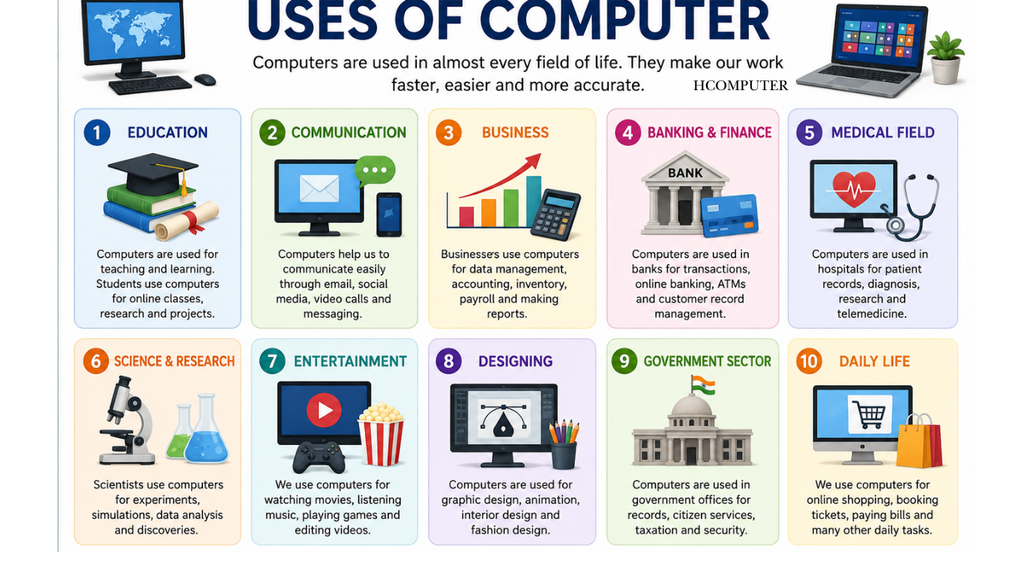
A computer is an electronic device that accepts data as input, processes it according to instructions, stores information, and produces useful output. Computers are used in almost every field of modern life.
1. Education
Computers are widely used in schools, colleges, universities, and training centers.
Uses:
- Preparing notes and assignments
- Online classes and examinations
- Research and information gathering
- Creating presentations
- Learning programming and other skills
- Accessing digital books and study materials
Example: Students can use a computer to attend an online class and prepare a project report.
2. Business
Businesses use computers to manage their daily operations.
Uses:
- Preparing documents
- Maintaining customer records
- Managing employees
- Creating invoices
- Managing inventory
- Preparing reports
- Business communication
Computers help businesses save time and reduce manual work.
3. Banking
Computers play an important role in banking and financial services.
Uses:
- Maintaining customer accounts
- Processing transactions
- Managing ATMs
- Online banking
- Generating account statements
- Processing loans
- Detecting suspicious transactions
For example, when you transfer money through online banking, computer systems process and record the transaction.
4. Communication
Computers make communication faster and easier.
Uses:
- Video conferencing
- Online messaging
- Social networking
- Sharing documents
- Voice and video calls
People can communicate with someone in another country within seconds.
5. Healthcare
Computers are used extensively in hospitals, clinics, laboratories, and pharmacies.
Uses:
- Maintaining patient records
- Scheduling appointments
- Managing medicines
- Medical research
- Laboratory data processing
- Hospital administration
- Medical imaging and analysis
Computers help healthcare professionals organize and process large amounts of information.
6. Science and Research
Scientists use computers to perform calculations, analyze data, create simulations, and conduct research.
Uses:
- Scientific calculations
- Data analysis
- Weather and climate research
- Space research
- Laboratory experiments
- Computer simulations
- Artificial intelligence research
Computers can process huge quantities of data much faster than humans can manually.
7. Government
Government departments use computers to provide and manage public services.
Uses:
- Maintaining citizen records
- Tax administration
- Digital services
- Government databases
- Preparing official documents
- Managing elections and public administration
- Online applications
Computers help government organizations manage large amounts of information efficiently.
8. Entertainment
Computers are an important part of the entertainment industry.
Uses:
- Watching movies and videos
- Listening to music
- Playing games
- Editing photos
- Editing videos
- Creating animations
- Streaming content
Modern movies and games also use computers for graphics, visual effects, and animation.
9. Designing and Graphics
Computers are used by designers, architects, engineers, and artists.
Uses:
- Graphic design
- Logo and poster design
- Building design
- 3D modeling
- Animation
- Photo editing
- Computer-aided design
Specialized software allows professionals to create and modify complex designs.
10. Transportation
Computers are used in cars, trains, airplanes, ships, airports, and railway systems.
Uses:
- Ticket booking
- Navigation
- Traffic management
- Flight scheduling
- Railway management
- Vehicle control systems
- GPS-based services
For example, online railway ticket booking depends on computer systems.
11. Manufacturing
Factories use computers to control and monitor production.
Uses:
- Machine control
- Production planning
- Quality checking
- Inventory management
- Product design
- Industrial automation
- Monitoring production processes
Computer-controlled machines can perform repetitive tasks with high precision.
12. Agriculture
Computers are increasingly used in modern agriculture.
Uses:
- Weather information
- Crop planning
- Farm management
- Soil data analysis
- Irrigation management
- Market-price information
- Agricultural research
Modern farms may combine computers with sensors, satellites, and automated equipment.
13. Online Shopping
Computers make electronic commerce possible.
Uses:
- Searching for products
- Comparing prices
- Placing orders
- Making digital payments
- Tracking deliveries
- Managing customer accounts
A customer can purchase products without visiting a physical store.
14. Offices
Computers are essential in modern offices.
Common uses:
- Typing documents
- Creating spreadsheets
- Preparing presentations
- Sending emails
- Maintaining records
- Printing documents
- Attending online meetings
- Managing projects
Applications such as word processors and spreadsheets are commonly used for office work.
15. Weather Forecasting
Computers process enormous amounts of weather information.
They are used to analyze:
- Temperature
- Wind speed
- Rainfall
- Atmospheric pressure
- Satellite observations
Computer models then help meteorologists prepare weather forecasts.
16. Defence and Security
Computers are used in defence and security systems.
Uses:
- Communication
- Data analysis
- Radar systems
- Simulation and training
- Monitoring systems
- Logistics and resource management
Because these systems can be highly sensitive, they require strong security and controlled access.
17. Personal Use
People use computers at home for many everyday activities.
Uses:
- Studying
- Working
- Paying bills
- Managing personal documents
- Watching videos
- Learning new skills
- Communicating with others
- Managing photographs and files
Advantages of Using Computers
Computers provide several important benefits:
- Speed — They can perform many operations very quickly.
- Accuracy — They can produce highly accurate results when given correct instructions and data.
- Storage — They can store large amounts of information.
- Automation — They can perform repetitive tasks automatically.
- Multitasking — They can handle multiple applications and tasks.
- Communication — They allow fast exchange of information.
- Productivity — They reduce the time required for many tasks.
Conclusion
Computers are used in education, business, banking, healthcare, communication, science, government, entertainment, transportation, agriculture, manufacturing, offices, and personal activities.
In simple words:
A computer is used to input, process, store, retrieve, and communicate information, making work faster, easier, and more efficient.
Pingback: LINK - hcomputer.in