
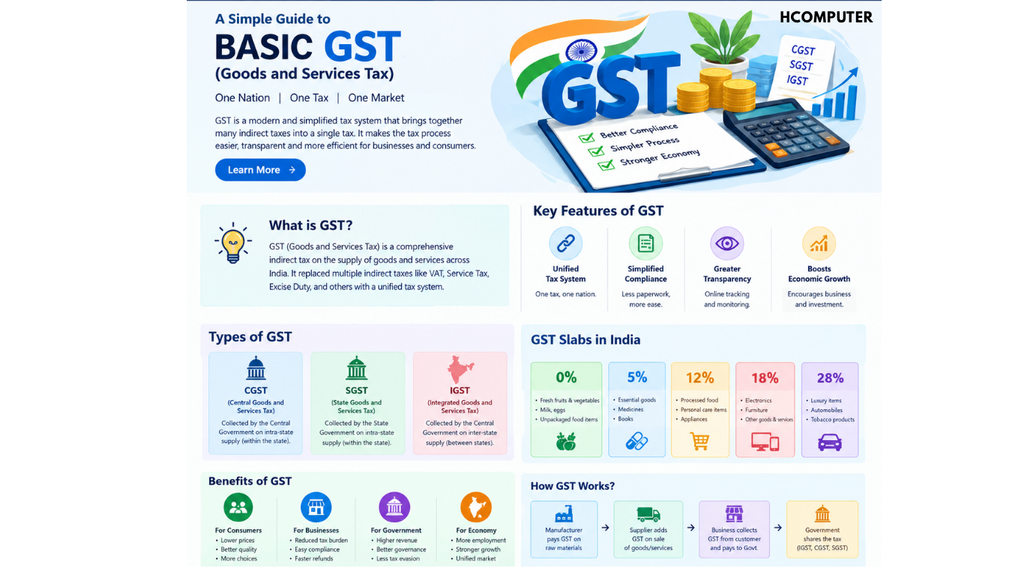
Here are easy, classroom-friendly GST notes useful for Tally Prime, computer courses (DCA/ADCA), accounting students and beginners.
1. What is GST?
GST (Goods and Services Tax) is an indirect tax imposed on the supply of goods and services in India.
GST was introduced in India on 1 July 2017. It replaced several indirect taxes such as VAT, Service Tax, Central Excise, etc.
Simple Example
Suppose a shopkeeper sells a product for ₹10,000 and GST is 18%.
GST = ₹10,000 × 18% = ₹1,800
Total invoice value = ₹10,000 + ₹1,800 = ₹11,800
2. Full Form of GST
G – Goods
S – Services
T – Tax
GST = Goods and Services Tax
3. Main Features of GST
- GST is an indirect tax.
- It is applicable to the supply of goods and services.
- GST is a destination-based tax.
- It was introduced on 1 July 2017.
- GST has replaced many earlier indirect taxes.
- GST is collected at different stages of the supply chain.
- Businesses can generally claim eligible Input Tax Credit (ITC).
- GST has different tax rates depending on the goods/services.
4. Types of GST
There are mainly four components:
1. CGST – Central Goods and Services Tax
CGST is collected by the Central Government on an intra-state supply.
2. SGST – State Goods and Services Tax
SGST is collected by the State Government on an intra-state supply.
3. IGST – Integrated Goods and Services Tax
IGST generally applies when the supply is made from one state/UT to another state/UT.
4. UTGST – Union Territory GST
UTGST applies to certain supplies within Union Territories that have a legislature framework where SGST does not apply.
5. CGST + SGST Example
Suppose a product costs ₹20,000 and GST rate is 18%.
GST = ₹20,000 × 18%
= ₹3,600
For an intra-state transaction:
CGST = 9% = ₹1,800
SGST = 9% = ₹1,800
Therefore:
| Particular | Amount |
|---|---|
| Product Value | ₹20,000 |
| CGST @ 9% | ₹1,800 |
| SGST @ 9% | ₹1,800 |
| Total Invoice | ₹23,600 |
6. IGST Example
Suppose a business in Uttarakhand sells goods to a registered customer in Delhi.
Product value = ₹20,000
GST = 18%
IGST = ₹20,000 × 18%
= ₹3,600
| Particular | Amount |
|---|---|
| Product Value | ₹20,000 |
| IGST @ 18% | ₹3,600 |
| Total Invoice | ₹23,600 |
Here, CGST and SGST are not separately charged.
7. Intra-State and Inter-State Supply
Intra-State Supply
When the supplier and place of supply are generally within the same state, it is an intra-state supply.
GST = CGST + SGST
Example:
Uttarakhand → Uttarakhand
Inter-State Supply
When the supply is generally between different states, it is an inter-state supply.
GST = IGST
Example:
Uttarakhand → Delhi
8. GST Tax Rates
GST rates depend upon the classification of goods and services.
Common rate slabs include:
- 0%
- 5%
- 12%
- 18%
- 28%
Some goods/services can also be subject to special rates or compensation cess where applicable.
Important: GST rates can change, so always verify the current rate for a particular product/service before preparing an actual invoice.
9. What is GSTIN?
GSTIN = Goods and Services Tax Identification Number
It is a 15-digit identification number allotted to a GST-registered taxpayer.
Example format:
05ABCDE1234F1Z5
The structure contains information such as the state code and PAN-related characters.
10. What is Input Tax Credit (ITC)?
Input Tax Credit means the eligible GST paid on purchases can generally be adjusted against GST payable on sales, subject to GST law and conditions.
Example
A business purchases goods:
Purchase value = ₹10,000
GST @18% = ₹1,800
Later, it sells goods:
Sale value = ₹15,000
GST @18% = ₹2,700
Eligible ITC = ₹1,800
GST payable after ITC:
₹2,700 − ₹1,800 = ₹900
So, the net GST liability is ₹900, assuming the ITC is fully eligible and all applicable conditions are satisfied.
11. Input Tax and Output Tax
Input Tax
GST paid on eligible business purchases.
Output Tax
GST collected/charged on taxable sales or supplies.
Basic Formula
Net GST Payable = Output Tax − Eligible ITC12. What is a GST Invoice?
A GST invoice is a document issued by a registered supplier for taxable supply of goods or services.
A GST invoice may contain:
- Supplier name
- Supplier address
- GSTIN
- Invoice number
- Invoice date
- Customer name
- Customer address
- Customer GSTIN, where applicable
- Description of goods/services
- HSN/SAC
- Quantity
- Rate
- Taxable value
- CGST
- SGST/UTGST
- IGST
- Total invoice value
13. HSN Code
HSN = Harmonized System of Nomenclature
HSN codes are used for classification of goods.
Example:
A business selling different products can use the relevant HSN code on its GST documents as required.
14. SAC Code
SAC = Services Accounting Code
SAC is used for classification of services under GST.
So:
Goods → HSN
Services → SAC
15. Composition Scheme
The Composition Scheme is a simplified GST scheme available to eligible small taxpayers, subject to prescribed conditions and limits.
Its major features generally include:
- Simplified compliance
- Payment of tax at prescribed composition rates
- Restrictions on certain types of supplies
- Generally, no normal ITC mechanism like regular taxpayers
- Taxpayer generally cannot collect GST separately from customers in the same manner as a regular taxpayer
Eligibility and applicable rates/limits should be checked under the current GST rules.
16. GST Return
A GST return is a statement containing information about supplies, purchases/ITC and tax liability, depending on the applicable return/form.
Common GST forms include:
GSTR-1
Contains details of outward supplies/sales.
GSTR-3B
A summary return used for reporting supplies, ITC and tax liability/payment.
There are other GST forms and statements depending on the taxpayer and circumstances.
17. Reverse Charge Mechanism (RCM)
Normally, the supplier is responsible for charging and paying GST.
Under Reverse Charge Mechanism, the recipient can be liable to pay GST in specified circumstances.
Normal mechanism:
Supplier → Charges GST → Recipient
Reverse charge:
Recipient → Pays GST → Government
RCM applies only in cases prescribed under GST law.
18. Exempt Supply
An exempt supply is a supply that is exempt from GST under the applicable provisions.
Certain goods and services may fall under exempt categories.
19. Nil-Rated Supply
A nil-rated supply is a taxable supply on which the applicable GST rate is 0%.
It is useful to understand that nil-rated, exempt, non-GST and zero-rated supplies are not necessarily the same thing.
20. Zero-Rated Supply
Zero-rated supplies mainly include:
- Exports
- Certain supplies to Special Economic Zones (SEZs), subject to applicable conditions
Zero-rating has special ITC/refund implications under GST law.
21. GST Calculation Formula
If price is before GST:
GST = Taxable Value × GST Rate / 100
Example:
Value = ₹50,000
GST = 18%
GST = ₹50,000 × 18 / 100
= ₹9,000
Total:
₹50,000 + ₹9,000 = ₹59,000
22. GST Calculation When Price Includes GST
Suppose the invoice amount including GST is ₹11,800 and GST rate is 18%.
Taxable value:
₹11,800 × 100 / 118 = ₹10,000
GST:
₹11,800 − ₹10,000 = ₹1,800
Therefore:
- Taxable value = ₹10,000
- GST = ₹1,800
- Total = ₹11,800
23. GST in TallyPrime
For accounting practice in TallyPrime, the basic workflow is:
Company Creation
↓
Enable GST
↓
Enter GSTIN & Registration Details
↓
Create Ledgers
↓
Create Stock Items
↓
Enter Purchase Voucher
↓
Enter Sales Voucher
↓
Record GST
↓
Check GST Reports
↓
Prepare/verify GST returns
Common GST Ledgers
For practice, you may create ledgers such as:
- Input CGST
- Input SGST
- Input IGST
- Output CGST
- Output SGST
- Output IGST
24. Simple TallyPrime Purchase Example
Purchased goods worth ₹50,000 within the same state at 18% GST.
CGST = 9% = ₹4,500
SGST = 9% = ₹4,500
Total purchase = ₹59,000
Basic accounting entry:
Purchase A/c Dr. ₹50,000
Input CGST A/c Dr. ₹4,500
Input SGST A/c Dr. ₹4,500
To Supplier A/c ₹59,000
25. Simple TallyPrime Sales Example
Sold goods worth ₹80,000 within the same state at 18% GST.
CGST = ₹7,200
SGST = ₹7,200
Total invoice = ₹94,400
Basic accounting entry:
Customer A/c Dr. ₹94,400
To Sales A/c ₹80,000
To Output CGST A/c ₹7,200
To Output SGST A/c ₹7,200
26. Important GST Terms
| Term | Full Form / Meaning |
|---|---|
| GST | Goods and Services Tax |
| CGST | Central Goods and Services Tax |
| SGST | State Goods and Services Tax |
| IGST | Integrated Goods and Services Tax |
| UTGST | Union Territory Goods and Services Tax |
| GSTIN | Goods and Services Tax Identification Number |
| ITC | Input Tax Credit |
| HSN | Harmonized System of Nomenclature |
| SAC | Services Accounting Code |
| RCM | Reverse Charge Mechanism |
| GSTN | Goods and Services Tax Network |
| GSTR | GST Return |
| SEZ | Special Economic Zone |
Quick Revision
Same State → CGST + SGST
Different State → IGST
Goods → HSN
Services → SAC
Purchase GST → Input Tax / ITC
Sales GST → Output Tax
Net GST = Output GST − Eligible ITC
GST introduced in India → 1 July 2017